
Thermostat Set Low but AC Still Not Cooling? Here's Why It Happens in Miami
Written by the team at Air Duct Cleaning Miami — Licensed FL HVAC Contractor #CAC1817115, BBB A+, 1,000+ South Florida homes served.
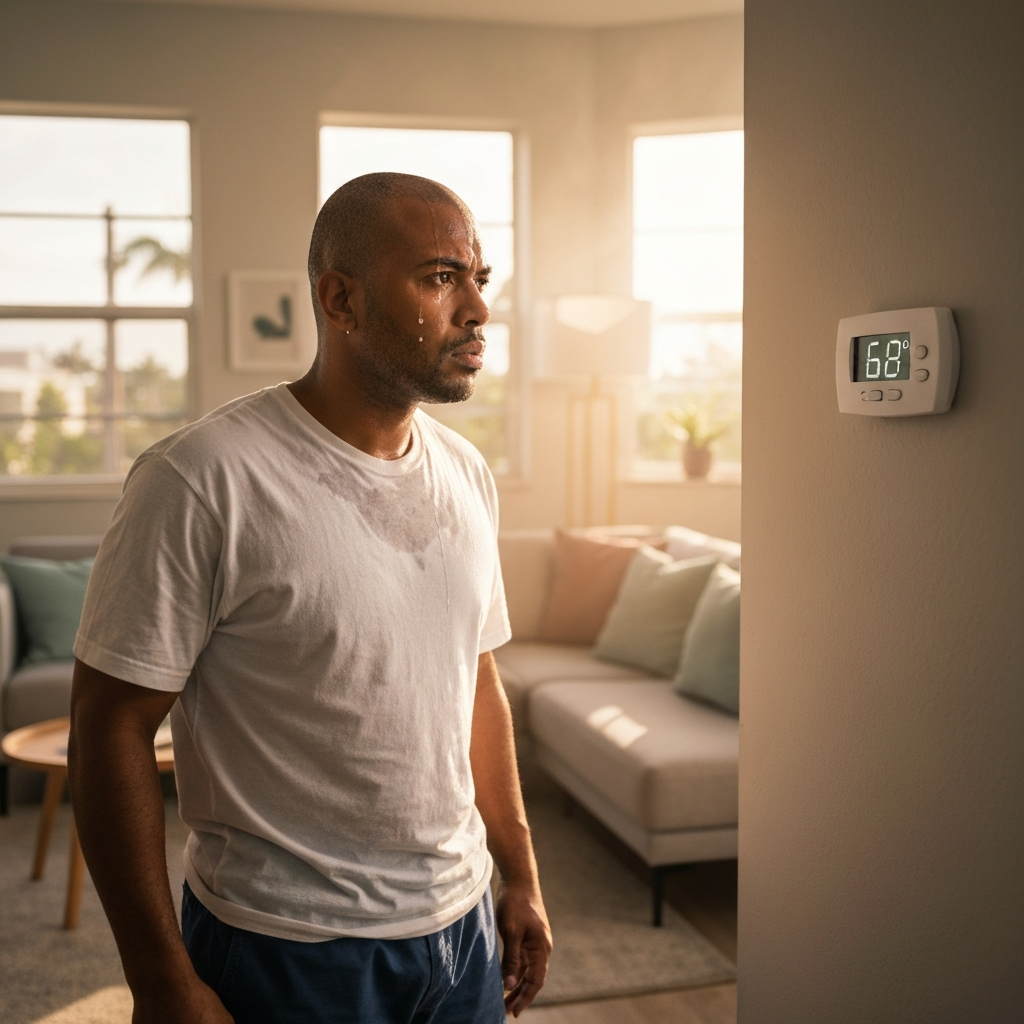
You set your thermostat to 68 and it's still 82 degrees inside your Kendall home at 3 PM in July. You've already tried the obvious fix. You turned it down. Nothing changed. If that's you right now, here is the direct answer: lowering the thermostat does not fix an AC problem — it just tells a broken system to work harder. The thermostat is the command center, not the engine. When your AC is not cooling even though the thermostat is set low, something in the mechanical system has failed or is severely restricted. You've already ruled out the simplest fix. Now it's time to diagnose the real cause.
We see this exact situation on service calls across Doral, Kendall, Homestead, and West Miami every summer. Licensed FL HVAC contractor #CAC1817115 here at Air Duct Cleaning Miami, BBB A+, over 1,000 South Florida homes serviced. The five most common causes are a clogged air filter, a frozen evaporator coil, low refrigerant from a leak, a failed capacitor, or a wrong thermostat setting. In this post we'll walk you through how to spot each one, what you can safely check yourself, and when you need a licensed tech at your door today.
Why Turning the Thermostat Down Does Not Fix the Problem
Think of your thermostat like the gas pedal in a car that won't start. You can press it all the way to the floor, but if the engine is broken, the car doesn't move. Same logic here. Your thermostat sends a signal to the system that says "cool the house to this temperature." The AC either has the capacity to do that or it does not.
In Miami's summer heat — 93 to 97 degrees outside, humidity at 80 to 90 percent — your AC is already working at maximum capacity just to keep up with the heat load pouring through walls, windows, and the roof. A 2-ton or 3-ton unit in a newer Kendall or Homestead home can typically hold somewhere between 74 and 78 degrees on a peak afternoon. If it can't even reach that, you don't have a thermostat problem. You have a mechanical problem.
Key point: Setting 68 when the house is 82 does not make the system blow colder. Your AC blows at one temperature regardless of the setpoint. A lower setting just means the system keeps running longer, which accelerates whatever failure is already happening.
Three Things to Check Before Calling a Tech
Before you call for service, run through this list. These take under five minutes and any homeowner can do them without tools.
1. Check the Thermostat Mode — COOL Not FAN
This sounds basic, but we find it on roughly one in twelve calls. If your thermostat is set to FAN or FAN-ONLY mode, the system blows air — but it is room-temperature air, not conditioned air. The fan runs, you feel airflow, but nothing cools down. Make sure the mode selector reads COOL, not just the fan symbol. If you have a Nest, Honeywell, or ecobee, look for the mode option under settings and verify it says "Cool."
2. Check the Air Filter
Pull out your filter and hold it up to a light. If you cannot see light through it, replace it immediately. A clogged filter is the single most common cause of an AC that runs constantly without cooling the house. Here is what happens: the filter blocks airflow to the evaporator coil (the cold metal component inside your indoor air handler). Without enough air moving across that coil, it gets too cold — below 32 degrees — and freezes solid. A frozen coil produces zero cold air. The system sounds like it is running normally, but no cooling is happening.
In Miami's dusty season from January through April, we see filters clogged solid within 4 to 6 weeks in homes with pets or older ductwork. Replace the filter, then give the system 2 to 4 hours with the fan running to thaw the coil. If it cools normally after that, a dirty filter was the only problem. If it freezes again within days, the filter is a symptom, not the root cause.
3. Check the Circuit Breaker
Your HVAC system has two separate breakers — one for the indoor air handler and one for the outdoor condenser unit. If the outdoor condenser's breaker trips, the indoor unit keeps running and blowing air. But without the outdoor unit compressing refrigerant, there is no cooling. Go to your breaker panel and look for the breaker labeled AC, HVAC, or CONDENSER. If it is in the middle position (not fully on, not fully off), it has tripped. Reset it once by switching it fully off, then fully on. If it trips again, do not reset it a second time — a repeated trip means an electrical fault that needs a licensed tech.
AC Won't Cool Even on Lowest Setting?
We diagnose the real cause — not just reset the thermostat. Licensed FL HVAC contractor #CAC1817115. Same-day service available across Miami-Dade and Broward.
(305) 607-3244 Get a Free EstimateThe Real Causes When Your AC Won't Cool After You've Lowered the Thermostat
If the three checks above did not solve the problem, one of these five mechanical failures is almost certainly what you are dealing with.
| Cause | What You Notice | DIY Safe? | Urgency |
|---|---|---|---|
| Frozen Evaporator Coil | Ice on copper lines near air handler, weak airflow, warm air from vents | Thaw only — no repair | Medium |
| Low Refrigerant (Freon Leak) | Hissing sound, ice on lines, AC runs all day, house never cools | No — EPA 608 required | High |
| Failed Capacitor | Outdoor unit hums but fan does not spin, or unit shuts off within minutes | No — electrical hazard | High |
| Dirty Evaporator or Condenser Coil | System runs but barely drops temperature, higher electric bill | No — professional cleaning required | Medium |
| Wrong Thermostat Wiring or Fault | Display shows setpoint reached even when house is still hot | Restart only — no rewiring | Low-Medium |
Frozen Evaporator Coil
The evaporator coil is the cold metal component inside your air handler — the part that actually cools the air passing through it. When airflow across the coil drops (from a dirty filter, closed vents, or collapsed duct), the coil temperature drops below freezing. Moisture in the air turns to ice on the coil, and a frozen coil cannot transfer cold to passing air. The result: your system runs continuously, uses electricity, and produces warm or barely cool air. You may see ice on the copper refrigerant lines near the air handler. The fix starts with turning the system to FAN ONLY for 2 to 4 hours to thaw — but the underlying cause (filter, airflow, or refrigerant) still needs a technician.
Low Refrigerant from a Leak
Refrigerant (sometimes called Freon, though that's a brand name for older R-22) is the substance that actually carries heat out of your home. It does not get "used up" — your system runs on a sealed loop. If refrigerant is low, that means it leaked. Low refrigerant means less cooling capacity. The system runs all day, the thermostat never reaches its setpoint, and your electric bill climbs. You may hear a faint hissing near the indoor or outdoor unit. Adding refrigerant without finding and fixing the leak is a temporary patch — the refrigerant will just escape again. Handling refrigerant requires an EPA 608 certification. This is not a DIY repair. We handle refrigerant leak diagnosis and recharge across all of Miami-Dade and Broward. See our full AC repair service for details.
Failed Capacitor
The capacitor is a small cylindrical component inside your outdoor unit. Think of it as the battery that kicks the compressor and fan motor into gear every time the system starts. When a capacitor fails, the outdoor unit hums but the fan either does not spin or spins slowly. Without the fan running at full speed, the condenser cannot release heat — and the whole system loses its ability to cool. Capacitors fail more often in South Florida because the heat and humidity here accelerates their degradation. We replace capacitors on calls in Hialeah, Doral, and West Miami every week from May through September. This is not a DIY repair due to the high voltage stored in the component even after the system is off.
Do not attempt to recharge refrigerant or replace a capacitor yourself.
Refrigerant handling without EPA 608 certification is a federal violation. Capacitors store lethal voltage levels even when the unit is unplugged. Both repairs require a licensed FL HVAC contractor. Attempting them yourself also voids most equipment warranties.
Same-Day AC Diagnostic — Miami-Dade & Broward
Turned the thermostat down and still sweating? We find the real cause — frozen coil, refrigerant leak, failed capacitor — and fix it right. Free estimate, no obligation.
(305) 607-3244Licensed #CAC1817115 • BBB A+ • 1,000+ homes served
Why This Problem Hits Harder in Miami and Broward
South Florida's climate pushes HVAC systems harder than almost anywhere else in the country. We have roughly 11 months of AC season, summer humidity that sits at 80 to 90 percent from June through October, and outdoor temperatures that regularly hit 93 to 97 degrees in peak afternoon hours.
What that means for your system: the "delta T" (the temperature drop your AC produces between the return air it pulls in and the supply air it pushes out) should be 18 to 22 degrees. In Boston or Chicago, a system that's slightly underperforming still manages to keep up because the outdoor temperature is lower. In a Kendall or Homestead home in July, a system that's operating at 85 percent efficiency instead of 100 percent literally cannot keep up with the heat load. The result is exactly what you're experiencing — thermostat set to 68, house stuck at 82.
We also see accelerated coil corrosion on homes in Coral Gables, South Miami, and along the coast where salt air from Biscayne Bay degrades aluminum fins faster than inland properties. A corroded condenser coil loses heat-transfer efficiency, which looks exactly like a refrigerant problem on the surface but has a completely different fix.
For a deeper look at why this happens specifically to South Florida systems, read our post on why your AC is running but not cooling in Miami — it covers the six most common causes in detail.
What Not to Do When Your AC Won't Cool
- Do not keep lowering the thermostat — 62 degrees on a malfunctioning system just runs up your FPL bill
- Do not pour water on the outdoor unit to "cool it down" — you can damage electrical components
- Do not close vents in unused rooms to "concentrate" cooling — this raises duct static pressure and accelerates coil freezing
- Do not reset the circuit breaker more than once if it trips again immediately
- Do not add refrigerant yourself — illegal without EPA 608 certification and useless without fixing the leak first
- Do not ignore a hissing sound from the unit — refrigerant leaks get worse, not better, on their own
For a broader list of what's happening when your system runs without cooling, our post on the 10 most common reasons your AC won't cool covers additional failure modes including dirty condenser coils, ductwork leaks, and wrong system sizing.
Free AC Diagnostic — We Find What's Actually Wrong
No guessing. No resetting the thermostat and hoping. We show up with tools, diagnose the real problem, and give you a straight answer with no-obligation pricing.
(305) 607-3244 Schedule DiagnosticFrequently Asked Questions
The thermostat is just the command — it tells your AC what to do. If the AC can't execute that command, the room stays hot. Common reasons include a clogged air filter starving the system of airflow, low refrigerant from a leak, a frozen evaporator coil, or a failed capacitor. Lowering the thermostat further just makes the AC run longer against the same underlying problem.
Check three things in order: (1) Confirm the thermostat mode is set to COOL, not FAN-only. FAN mode circulates air without cooling it. (2) Check your air filter — if it's grey and packed tight, replace it immediately. (3) Look at your circuit breaker — if the outdoor condenser's breaker tripped, the indoor air handler runs but produces no cold air. If all three check out and the house is still hot, you need a licensed HVAC tech.
Yes, and it's one of the most common causes we find on service calls across Doral, Kendall, and Homestead. A clogged filter blocks airflow to the evaporator coil — the cold part inside your indoor unit. Without enough air moving across it, the coil gets too cold and freezes solid. A frozen coil produces zero cold air. The system runs all day but your home stays hot. Replacing the filter is free to fix, but the frozen coil needs 2 to 4 hours to thaw before you'll feel any improvement.
Your AC runs at one speed regardless of the thermostat setting — lower is not faster, it just means the system runs longer to reach a colder target. In Miami's summer heat (95 degrees outside, 85% humidity), a 2-3 ton unit in a newer Kendall or Homestead home may not be able to drop below 76 to 78 degrees on a peak afternoon without a tune-up. If you set 68 and the house tops out at 80, the system is either undersized, underperforming, or has a mechanical fault that needs a licensed tech.