

Buying a Home in Miami Without an AC Inspection Is the Most Expensive Mistake You Can Make
You need an AC inspection before buying a home in Miami — and a standard home inspection does not count as one. A home inspector confirms your AC turns on and blows cool air. A licensed HVAC contractor tells you whether the compressor is three months from a $12,000 failure. In South Florida, where the AC runs 10 to 12 months a year and systems wear out 40% faster than in northern states, that gap is the difference between a smooth closing and a financial emergency you had no idea was coming.
We are a licensed Florida HVAC contractor (CAC1817115) with a BBB A+ rating and 1,000+ South Florida homes serviced. We perform pre-purchase AC inspections for buyers, their realtors, and real estate attorneys throughout Miami-Dade and Broward County. In this post, we will walk you through what a licensed AC inspection actually covers, how Florida disclosure law leaves buyers exposed, what the real cost risk looks like, and why smart realtors in Coral Gables, Coconut Grove, and Aventura are adding this to every transaction as standard practice.
"We just closed on our Coral Gables home last month. The inspector said the AC was 'functional.' Two weeks later the compressor failed. The repair quote was $11,000." This is not an edge case. We hear a version of this story multiple times per month.
What a Home Inspector Checks vs. What a Licensed HVAC Contractor Checks
A home inspector is a generalist. They are trained to evaluate 10 to 15 different systems in your house in about two to three hours. On the AC, they verify it turns on, verify it blows air that is cooler than room temperature, and note obvious visible damage. That is it. They do not carry refrigerant gauges. They do not have amp meters. They do not measure airflow at each register.
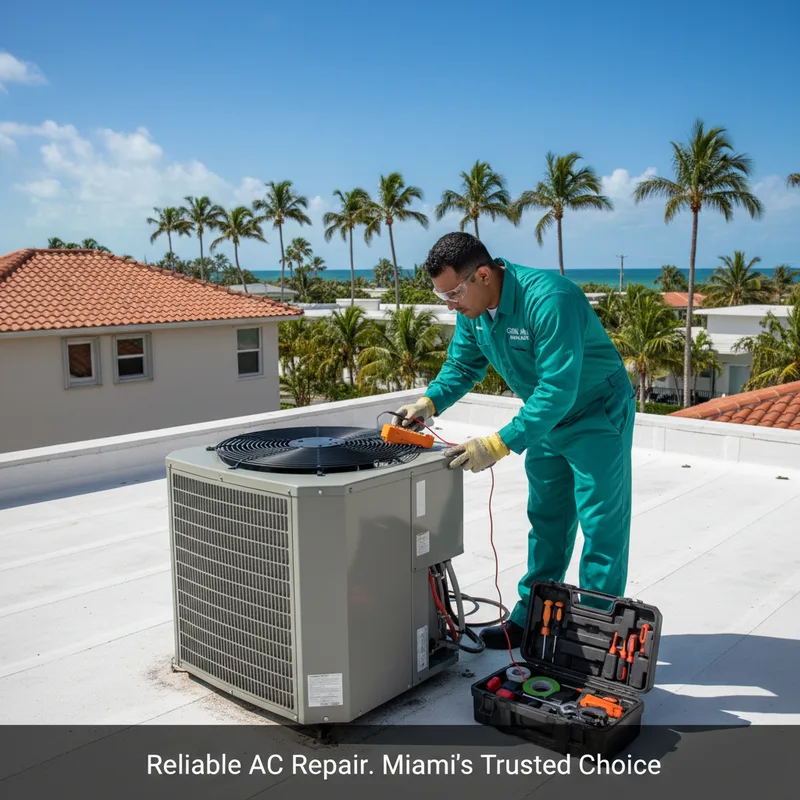
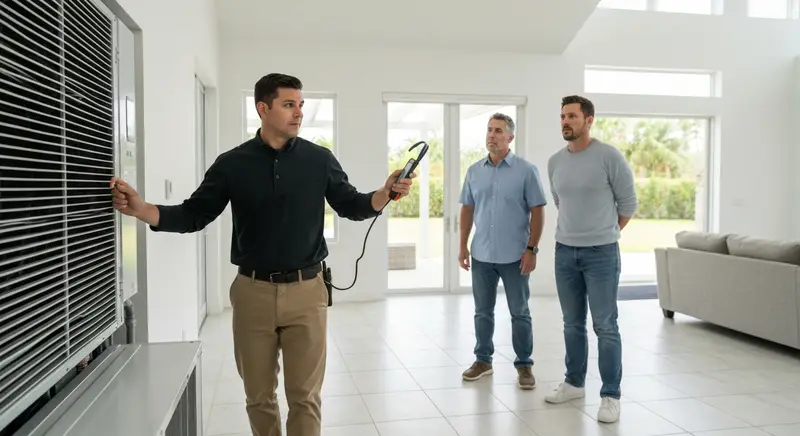
A licensed HVAC contractor performing a pre-purchase inspection does something entirely different. Here is the actual difference:
| What Gets Checked | Home Inspector | Licensed HVAC Contractor |
|---|---|---|
| System turns on | Yes | Yes |
| Blows cool air | Yes (basic) | Yes + temperature delta measured |
| Refrigerant charge level | No | Yes — gauges required |
| Compressor amp draw | No | Yes — predicts imminent failure |
| Capacitor & contactor condition | No | Yes — most common failure parts |
| Evaporator coil & drain pan | No | Yes — mold, corrosion, blockage |
| Ductwork condition | Visual only | Yes — leaks, mold, disconnected runs |
| Remaining life estimate | No | Yes — written in report |
| Negotiation documentation | No | Yes — written condition report |
The compressor amp draw test alone is worth the cost of the inspection. If a compressor is drawing 20% over its rated amperage, it is overworked and overheating. It may run fine today. In July, when it is running 18 hours a day in 95-degree heat, it fails. A home inspector will never catch this. A licensed HVAC contractor catches it every time.
For the full picture on what this service involves, see our AC maintenance and inspection service or request your free AC inspection estimate.
The Real Cost Shock: $12,000 to $17,000 and You Did Not See It Coming
Here is the scenario we see repeatedly. A buyer closes on a home in Miramar or Doral. The home inspector marked the AC as "functional." The system is 9 years old — not brand new, but nothing alarming on paper. Six weeks after closing, the compressor locks up in the middle of July.
The repair quote comes back at $11,000 to $17,000 for a full replacement. Not because something dramatic happened — but because a 9-year-old system in South Florida that was never properly maintained, running year-round in heat and humidity, finally reached its end of life. And nobody told the buyer.
In South Florida, AC systems run 10 to 12 months a year. That is roughly twice the annual runtime of a system in a northern state. A 10-year-old Miami AC has the wear equivalent of a 20-year-old system in Chicago. When a home inspector in a northern state sees a 10-year-old AC and calls it "functional," that is accurate. When the same assessment is applied to a South Florida home, it can be dangerously misleading.
Full AC replacement costs in 2026 are no longer what they were two or three years ago. Learn how much AC replacement costs in South Florida in 2026 — the tariff-driven price surge has pushed standard replacements to $10,000 to $17,000, with high-efficiency systems higher. Knowing the system's real condition before you close is the only way to negotiate a price that reflects that risk.
The negotiation math: A written HVAC inspection report showing a compressor drawing 22% over rated amperage and a refrigerant charge 28% low is worth $4,000 to $6,000 in seller credits. Or it becomes a condition requiring full replacement before closing. Either way, you do not absorb the cost alone after the deed transfers.
How Older Miami Homes Multiply the Risk
Not all risk is equal. Certain property types in Miami-Dade and Broward carry significantly higher pre-purchase AC risk than others.
Coral Gables and Coconut Grove historic homes often have original ductwork from the 1960s and 1970s — asbestos-containing duct insulation in some cases, heavily leaking flex duct in others. The AC unit itself may be newer, but if it is pushing conditioned air through 50-year-old ductwork with 30% leakage, you are paying to cool the attic, not the house. A home inspector will not catch this. We do.
New construction in Doral and Miramar carries a different risk. Builder-grade equipment is installed to meet code, not to last. We regularly see brand-new homes in these areas where the AC was installed with the refrigerant charge set by pressure alone (not by weight or superheat/subcooling measurements), leaving the system running 10 to 15% undercharged from day one. That shortens compressor life by years.
Aventura and Brickell condos have a unique issue: maintenance history gaps. In a condo building, individual unit AC maintenance depends entirely on whether the prior owner kept up with it. Most did not. We see evaporator coils black with mold, drain lines completely blocked, and capacitors swollen to the point of failure — on units that "turned on and blew cold" at the inspection.
Buying a Home in Miami-Dade or Broward?
Get a licensed HVAC pre-purchase inspection before you close. We work around your timeline and provide a written condition report you can use at the negotiating table.
Same-day available • We serve all of Miami-Dade & Broward County
FL Statute 689.261: The Disclosure Law That Sounds Better Than It Is
Florida Statute 689.261 requires residential sellers to disclose known material defects — including HVAC defects — before closing. If a seller knows the compressor is failing and does not disclose it, they have a legal problem.
The operative word is "known."
Most sellers are not HVAC technicians. They know the AC turns on. They do not know the compressor is drawing 22% over rated amperage. They do not know the refrigerant charge is 28% low. When the compressor fails three weeks after closing and the buyer threatens legal action, the seller’s attorney makes one argument: "My client did not know."
Without documented prior knowledge — a service record, a prior inspection report, a written technician recommendation — that argument holds up. The disclosure law protects you from sellers who actively hide known defects. It does not protect you from sellers who simply never had the system properly diagnosed.
A pre-purchase AC inspection solves this completely. If the inspection reveals defects, you have written documentation of the system’s condition before the deed transfers. There is no ambiguity about when the problem existed. You can require the seller to repair or replace as a closing condition, negotiate a credit, or walk away. After the deed transfers, your options narrow significantly.
When you are ready to schedule, our team at Air Duct Cleaning Miami works directly with real estate agents, title companies, and buyers to complete inspections within closing timelines. We provide written reports in a format that attorneys and real estate professionals can use directly in negotiations.
Why Smart Miami Realtors Add This to Every Transaction
The best realtors we work with in Hallandale Beach, Pembroke Pines, and Coconut Grove have stopped treating a licensed HVAC inspection as optional. They recommend it on every transaction — not because it protects the buyer from the seller, but because it protects the buyer from an honest mistake.
A realtor who recommends a licensed HVAC inspection and it reveals a $14,000 problem before closing is a hero. A realtor whose client closes without one and discovers the problem after — that relationship is difficult to repair.
For realtors in South Florida, the math is simple. An AC inspection is a small cost relative to a transaction. It produces a written report. If the system passes, the buyer has documented confidence and the deal closes smoothly. If it fails, the realtor has the tool to renegotiate from a position of documented fact, not suspicion.
We offer scheduling flexibility for transactions on tight closing timelines. For our full approach to choosing a licensed HVAC contractor in Miami, that post also covers the red flags to watch for and the license verification steps that protect both buyers and agents.
Frequently Asked Questions
A licensed HVAC contractor performs a full diagnostic: refrigerant charge measurement, compressor amp draw test, capacitor and contactor inspection, evaporator coil and drain pan check, ductwork visual inspection, and airflow measurement at registers. You receive a written condition report with the system’s current status and estimated remaining life — usable directly in price negotiations or as a closing condition requirement.
No. A home inspector confirms the system turns on and blows cool air. They do not carry refrigerant gauges, amp meters, or airflow tools. They cannot detect a compressor drawing over rated amperage, a refrigerant charge 30% low, or a drain line 48 hours from flooding the air handler closet. In South Florida, where AC runs nearly year-round, these are exactly the failure modes that hit buyers weeks after closing.
Only if you can prove the seller had prior knowledge of the defect. The statute requires disclosure of known material defects. Sellers who never had the system properly diagnosed can claim they did not know. A pre-purchase inspection creates documented evidence of the system’s condition before the deed transfers — removing all ambiguity about when the defect existed.
A failing or near-end-of-life system can justify a $4,000 to $6,000 seller credit, or full replacement as a closing condition. Full AC replacement in South Florida in 2026 averages $10,000 to $17,000. Even a partial credit represents substantial real money on a transaction where you are already stretched. The inspection report is the documentation that makes that negotiation possible. Read more about current AC replacement costs in South Florida.